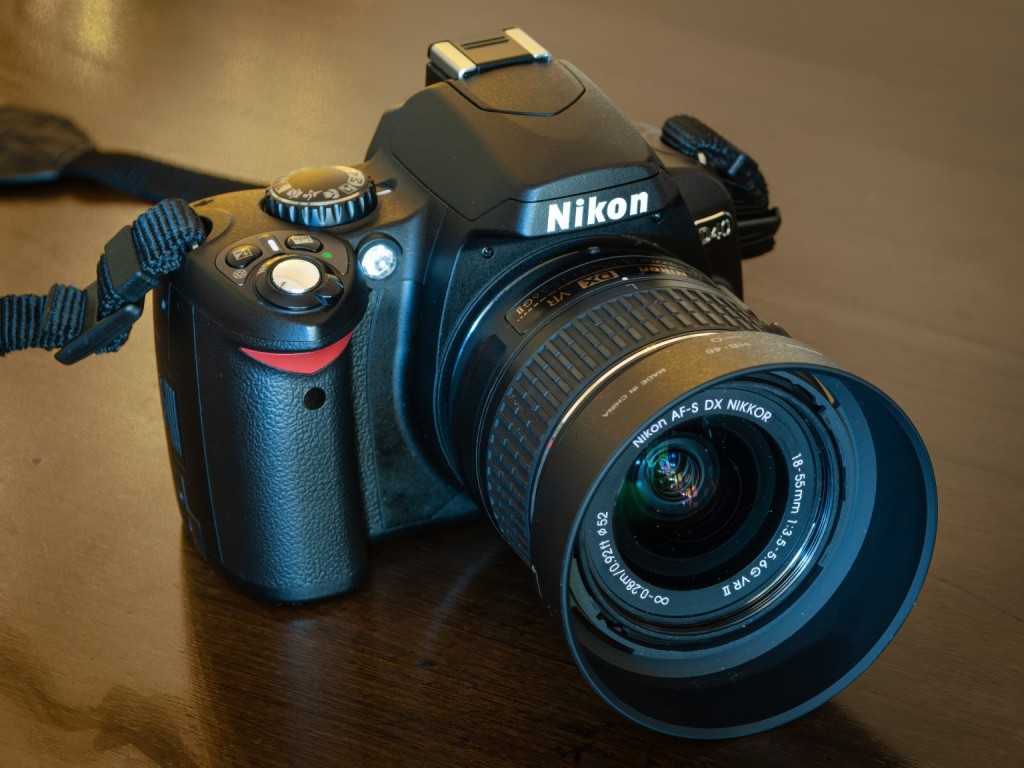
The Camera World in Late 2006
It’s easy to look back at old cameras and and their specifications and wonder why someone would have bought X when Y clearly had better specifications but that conveniently ignores pricing…
Back in 2006 I was looking to buy my first digital SLR as I felt I had reached the limit of what I could do with my current digital compact camera. While I was happy with the image quality in general, I often missed shots due to to slow performance, not just the autofocus speed but the general sluggishness of the camera. I wanted something with faster responses and the ability to create some blurrier backgrounds when shooting portraits, like I used to with my old film SLR in the early 90’s. The only problem was the cost… DSLR’s were still very expensive with the big manufacturers concentrating on the top end of the market to justify the cost of the technology and beginner models only just making it below $1,000 ($1,500 in 2025 money), still too much for me.
Then Nikon announced the D40 at a breakthrough price…
To better understand the significance let’s take a look at the prices Nikon and Canon were charging for their DSLR’s at various product levels, from full on pro level bodies down to their beginner offerings. Note that the EOS 350D in the table below only got a price reduction to the amount shown after the 400D launched and while it would later get a further cut to $699 in response to the Nikon D40, it was still more expensive.
| Make/Model | Type | Megapixels/ Sensor Size | Price in 2006 | Price – inflation adjusted to 2026 |
|---|---|---|---|---|
| Nikon D2xs | Pro DSLR | 12 / APS-C | $4,699 body only | $7,799 |
| Canon EOS 1D Mark IIn | Pro DSLR | 8 / APS-C | $3,999 body only | $6,599 |
| Canon EOS 5D | Semi Pro DSLR | 12 / FF | $3,299 body only | $5,499 |
| Nikon D200 | Semi Pro DSLR | 10 / APS-C | $1,699 body only | $2,799 |
| Canon EOS 30D | Enthusiast DSLR | 8 / APS-C | $999 body only | $1,599 |
| Nikon D80 | Enthusiast DSLR | 10 / APS-C | $999 body only | $1,599 |
| Canon EOS 400D (Rebel XTi) | Beginner DSLR | 10 / APS-C | $899 with 1 lens: EFS 18-55mm | $1,499 |
| Canon EOS 350D (Rebel XT) | Beginner DSLR | 8 / APS-C | $799 with 1 lens: EFS 18-55mm | $1,299 |
| Nikon D40 | Beginner DSLR | 6 / APS-C | $599 with 1 lens: AFS 18-55mm $799 with 2 lens: AFS 18-55mm AFS 55-200mm VR | $999 $1,299 |
| Canon PowerShot G7 | Point and Shoot | 10 / 1/1.8″ | $549 | $899 |
| Nikon Coolpix P3 | Point and Shoot | 8 / 1/1.8″ | $499 | $799 |
At under $600 with a lens the D40 was only $50-$100 more than a premium digital compact camera, and actually less than I had paid for my Olympus 8080WZ compact just 2 years before! The problem was the megapixel count, at just 6 megapixels it had fewer than my those compacts which packed 8-10 million and it didn’t make sense to me to go backwards. Canons offering, although $200 or 1/3rd more expensive was at least 8 megapixels. This was the height of the megapixel wars and I didn’t yet understand that this simply wasn’t important.
Contemporary Reviews
I scoured the review sites back then, DPReview, Imaging Resource, CameraLabs and upon Googling, a couple of extra sites I wasn’t previously familiar with, one run by a photographer called Thom Hogan and another by Ken Rockwell. All these reviews suggested the D40 was a great camera but it was Ken Rockwell in particular who convinced me that I didn’t need more pixels and that the higher quality 18-55 Nikon kit lens vs the Canon 18-55 was more important to the photo quality. While he seemed to have some very strong opinions, not all of which I agreed with, I did understand his view that the photographers eye and skill is what makes great images, not camera features and megapixels. Given the pricing at the time, my choices were either sticking with my compact camera or going with the D40 so the point was moot…
To give context from the time here are some quotes from their articles:
DPReview gave the camera a “Highly Recommended” rating and an excellent value assessment:
In everyday use the D40 is just what it set out to be, a very capable, compact, lightweight and easy to use camera which makes a perfect first step for anyone wanting to get into digital SLR photography. It provides enough control and a large enough range of manual settings to enable you to experiment and learn but also helps you to take great pictures in the process. It’s one of those cameras you can just pick up and start shooting without fuss, that you can hand to a friend who’s never used an SLR and know they’ll be able to do the same. All of this and a pretty decent kit lens for $600, I’d say it’s a bit of a bargain.
Imaging Resource said:
I can tell you that the Nikon D40 is one of the finest family cameras on the market. I’ve really enjoyed shooting with it, and would seriously consider it as a second camera to something like a D80, D200, or 30D. Those cameras are great for more serious work, but they’re also more bulky. The D40 is a camera for capturing fun and family. Its size and design are better suited for such duty. And you can still slap high quality glass on it and shoot with the pros on occasion if you like. The Nikon D40 is perfect for slipping into a small daypack for a hike or picnic. It doesn’t take a lot of space, and it comes out of the bag quickly. It focuses and shoots so quietly, you’re less likely to scare the animals you’re trying to capture. Nikon has some excellent inexpensive lenses to add to your kit for just such a purpose
Nikon really shocked the market with the D40. We’ve been pleasantly surprised with its excellent performance in low light and its simple grace as a day-to-day shooter. Then we remind ourselves that all this quality comes at less than $600, and we shake ourselves awake. The Nikon D40 is one great camera!
The Nikon D40 stands up well against the competition — even those with higher resolution — with great image quality at all speeds, and near-perfect utility as a family camera. It’s tough to ask for more. The Nikon D40 lives up to our expectations, and even exceeds them.
Thom Hogan‘s view:
The D40 is likely to be Nikon’s only 6mp and entry-level DSLR for awhile. As such, it goes up against the Pentax K100 series, used bodies, high-end compact digicams, and a host of other products. And I think it’ll hold its own.
First, the image quality is excellent. Nikon has proven once again that they know how to suck every last little bit of quality out of the 6mp sensors they’ve been using for more than four years. And amazingly, the included kit lens doesn’t let the sensor down. For those that aren’t trying to shoot wall murals and are satisfied with the size prints you’d get off, say, a really good desktop inkjet, there’s nothing to complain about in image quality until you get to ISO 3200, and even then some will find it usable at smaller print sizes.
But the impressive thing about the D40 is that it is arguably the best-designed small camera to date. Handwise, it’s perfect. The viewfinder is good, if not up to the D200 level. The controls are sensible and what we Nikon users expect. And the moving of the top LCD to the color LCD, while still with some slightly rough edges, turns out to be a lot more useful than you’d expect. As I note in the handling section, you can do 99% of the settings you’re likely to make while shooting without dropping into the actual menus. Nikon almost hit a home run with that, and frankly, why their top end Coolpix cameras don’t borrow the best aspects of this design I don’t know. Color, noise, and resolution are quite good, and you have enough control over the first two items to get excellent image quality.
Ken Rockwell, a popular and sometimes controversial but independent photography reviewer, strongly recommended the D40:
My favorite SLR camera just happens to be the cheapest SLR camera: the incomparable Nikon D40.
Even with 6 megapixels I can make stunning 12 x 18″ prints. If you can’t make a sharp shot with the D40, a more expensive camera isn’t likely to help you. Contrary to what salespeople try to get you to believe, megapixels have nothing to do with sharpness.
This is all you really need. I go on vacations for a week at a time with my super-lightweight D40, 18-55mm and SB-400 flash, and never miss anything. In fact, I love not having to carry more gear! The D40 battery lasts so long, about 500 – 1,000 shots, that you might be able to leave the charger at home if you’re feeling lucky.
No one, not even me who uses his cameras all day long, needs anything better than a D40. Guys who own fancy cameras may not have the confidence to admit it and poke fun at the D40, but I love it.
I own fancier cameras because they make it even easier to do fringe-element things, like make 6-foot-wide prints that are still sharp close up (prints from a D40 look great at any size when seen from a reasonable distance), or shoot with bizarre wide angle lenses, or burn away at 10 frames per second for sports. No one needs this, but if you have the cash or use cameras so much that even little improvements are appreciated, go for it.
Be the first to comment