Resolution & Sharpness
The greatest concern about buying or using a near 20 year old camera, and a low end beginners one at that, is image quality. It’s easy for side by side tests to show great improvements, particularly pixel peeping given our modern high megapixel sensors and bringing up shadows from seemingly near black until they are no longer shadows any more. All very impressive, and probably has a lot of us upgrading our gear on a regular cadence, and certainly we wouldn’t want to go back to a 6 megapixel camera with very little dynamic range because that would produce fuzzy, low quality images that we would consider unusable these days, right??? Well, just how bad is such a camera in reality? Let’s find out!
I took the camera out on my local walk with the 55-200mm kit lens and took the shot below as a test. Let’s take a look at it:
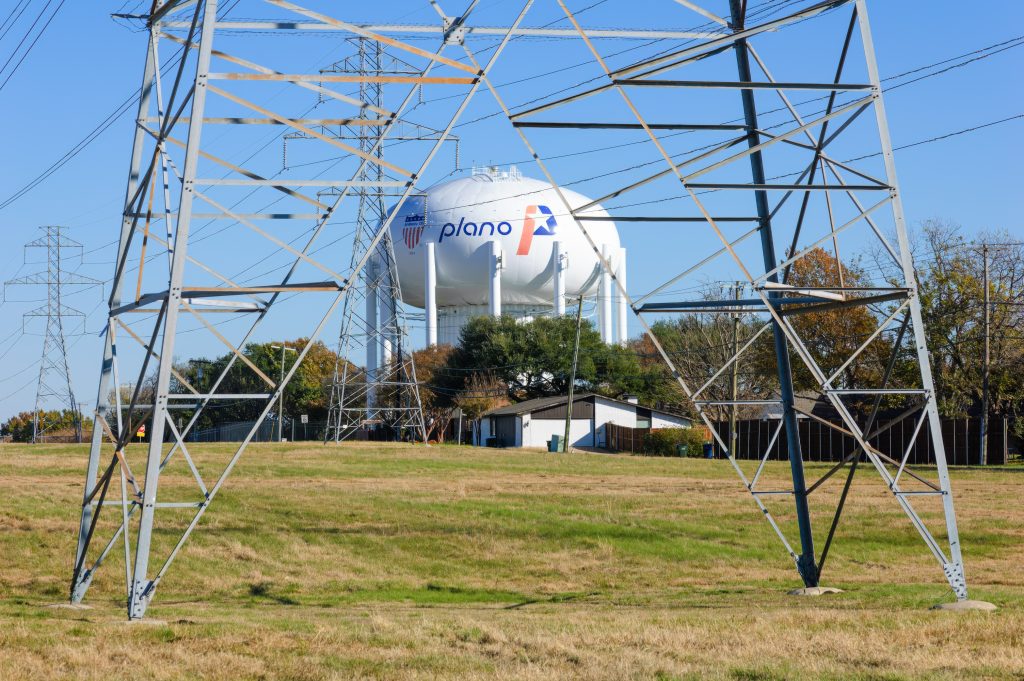
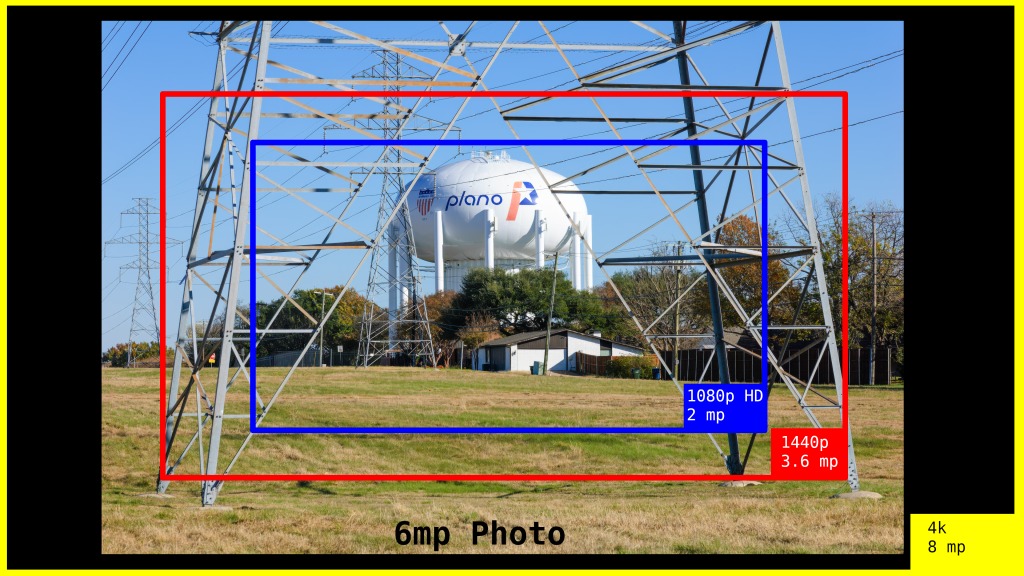
The first thing to consider is the 6 megapixels… I’ve overlaid the image and 3 common, modern monitor sizes below. It’s worth noting that while you would need a 7 megapixel camera to fill a 4k monitor vertically, on anything less you cannot display fit the whole image on the screen unless you size it down or zoom out which means the resolution is simply wasted. In other words, if your images are only going to be viewed through a screen, 6 megapixels is more than enough and according to the November 2025 Steam survey (which is of gamers who buy the latest and greatest computers), 96% of people are using a screen of 1440p resolution or less so 4k is extremely niche!
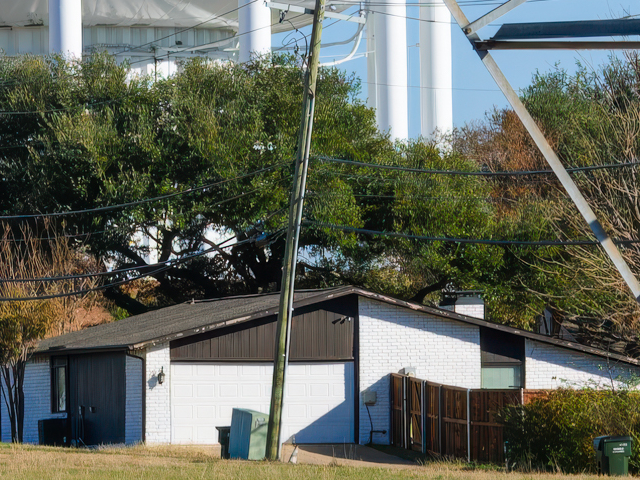
But for those who like to pixel peep at details vs looking at the photo as presented (the kind of people who don’t stand back and look at the Mona Lisa, instead they go up close and analyze her eyeball), we can look at some closeup crops in 1:1 size which show just how sharp this cheap camera and lens combo is…
Here is a crop from the center of the frame. The image is razor sharp and shows a lot of pixel peeping detail for “just” 6 megapixels. Dynamic range is a problem for older cameras, but note the panel detail on the white garage door lit by the early afternoon Texas sun AND the recovered detail in the fence panels that are in full shade. You can’t reads the writing on the side of the garbage can, but you wouldn’t be able to with a modern 24 megapixel camera either as it would only be twice as tall and wide… And would the ability to read that “make the photo”? I’d suggest not…
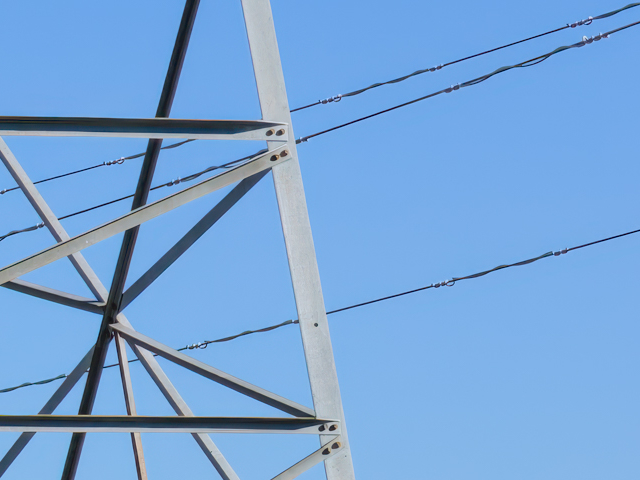
A problem with DSLR lenses, especially cheaper kit ones is that the corners are often quite blurry however when you take landscape shots like this you tend to stop down and they normally improve. I’d say corner sharpness is very good at least when stopped down to f/8:
There have only been two other worthwhile improvements in digital cameras over the past twenty years, dynamic range and noise control at higher ISO’s. Let’s take a look at noise first…
Noise
Unlike modern cameras with ISO’s in the 5 or even 6 digits, the D40 maxes out at 1,600. It does have a fake “Hi” mode above that but I wouldn’t recommend using that on new cameras much less old ones. To compound the problem, contemporary reviews said that the noise performance was just about usable at ISO 800, but too noisy to be of any use at it’s maximum ISO 1,600. Certainly it’s a very noisy image at those settings compared to a modern camera, here’s an example I took with the 18-55mm kit lens wide open at 55mm (i.e. f/5.6) indoors in dim light where I had to use ISO 1,600 to get a fast enough shutter speed for a steady shot:

When the image is downsized the noise disappears but when we look at 1:1 size we can see it… These days however there is de-noising software that could not have been imagined 20 years ago and running the image through that cleans it up beautifully with no loss of detail:
While again we don’t really notice any difference on the downscaled version, at 1:1 we can see how clean it is now.
This means ISO 1,600 is perfectly usable today and means we can take photos indoors at hand-holding shutter speeds even on a “slow” kit lens, albeit with the help of VR without worrying about noisy images.
Dynamic Range
Dynamic range has always been a problem with cameras, our eyes can handle 20 to 30 stops between highlights and shadows as out brain stitches the image together but modern cameras max out at 14 and are especially prone to clipping highlights which creates a very ugly effect. CCD cameras from 20 years ago maxxed out at around 8 stops and would blow the highlights earlier. The solution then, as today, was to underexpose the entire image to ensure that the bright areas were correct and thus “protected”, then use post processing software to bring up the exposure of the mid range and shadows to create a correctly exposed final image. Modern sensors capture a lot more detail in the shadows than those of 20 years ago so there is a limit in how much you can recover, but again, modern software can really make the most of what is there to give a much more acceptable image than we could have achieved back then.
To test what was possible I took this shot of the fence and leaves backlit by an incredibly bright morning sky. I had to underexpose by about 1.5 stops to keep the pale blue in the sky which resulted in the leaves being underexposed, and the fence was almost black:
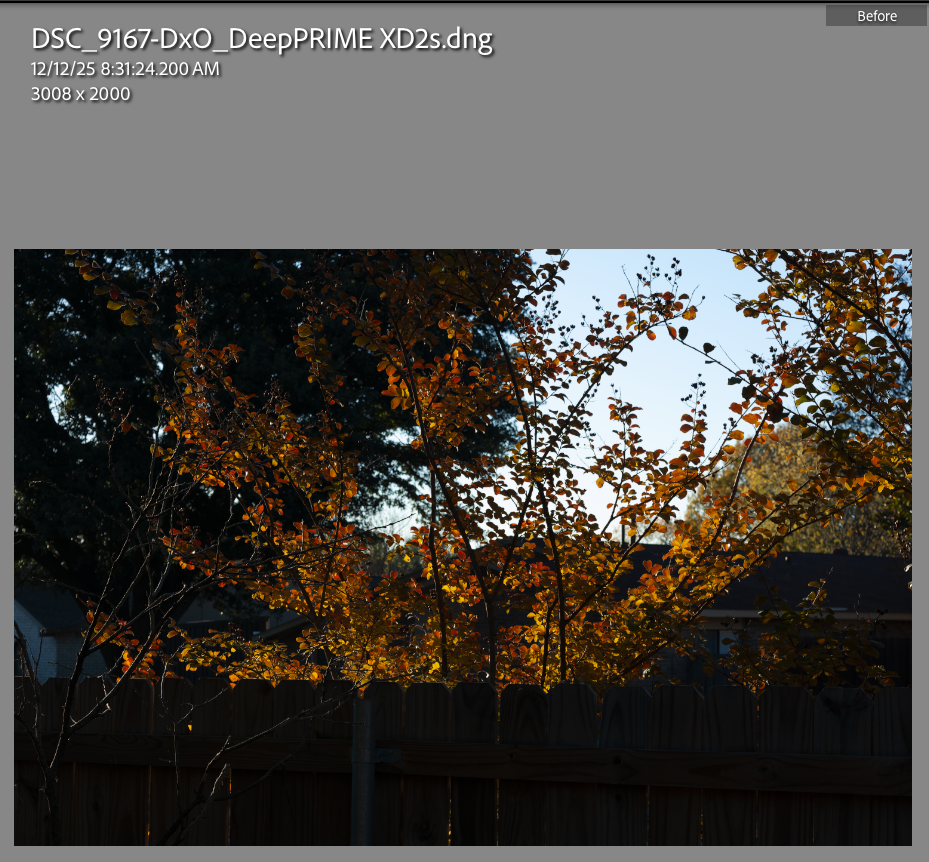
I then brought the exposure up 1.4 stops which made the leaves nice and bright, however this of course blew out the sky so I slid the highlight recovery slider all the way 100% to the left to recover it, then brought up the shadows by 70/100 to reveal the fence before boosting the colors slightly as you can see below. This entire process took less than a minute so it’s not much work:
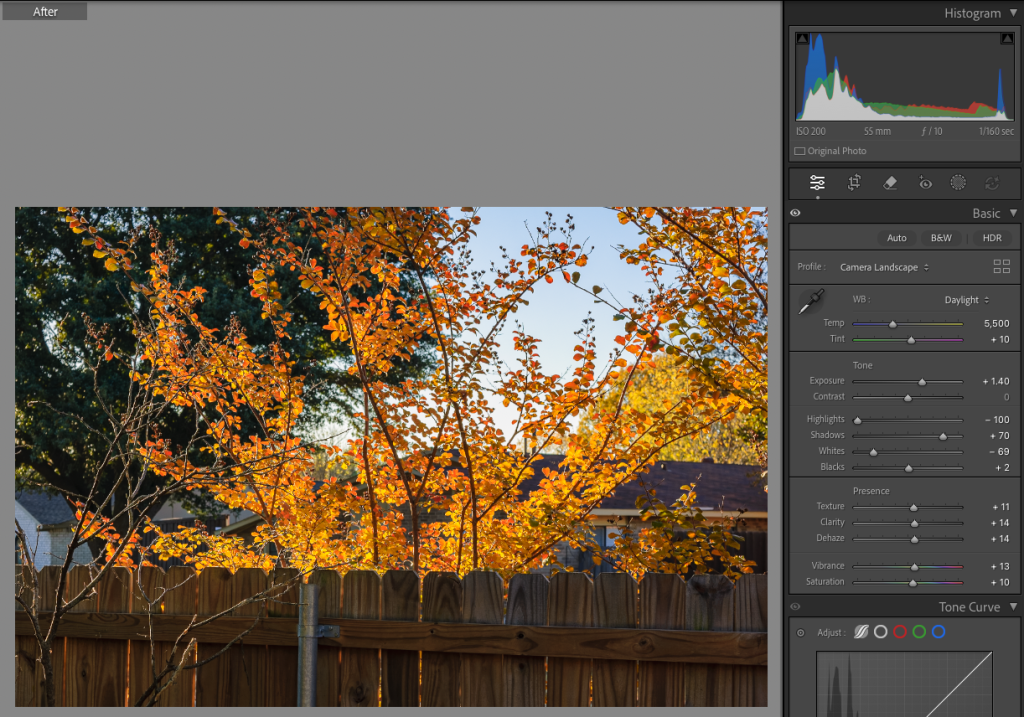
We now have our nice morning sun lit leaves as my eyes saw them, the sky retains it’s pale blue and we can even see some detail in the fence. With a modern camera we could brighten that even further but it’s important to remember that the fence is supposed to be in shadow, if we make it too bright our brains will correctly realize there is something wrong with the picture, that it looks “fake”. Just because we can do something in post does not mean we should…
A newer camera would capture a lot more details in the shadows then this D40 but I would argue there is enough there assuming we’re not pixel peeping. Click below for a 1:1 (100% zoom) crop of the before and after side by side:
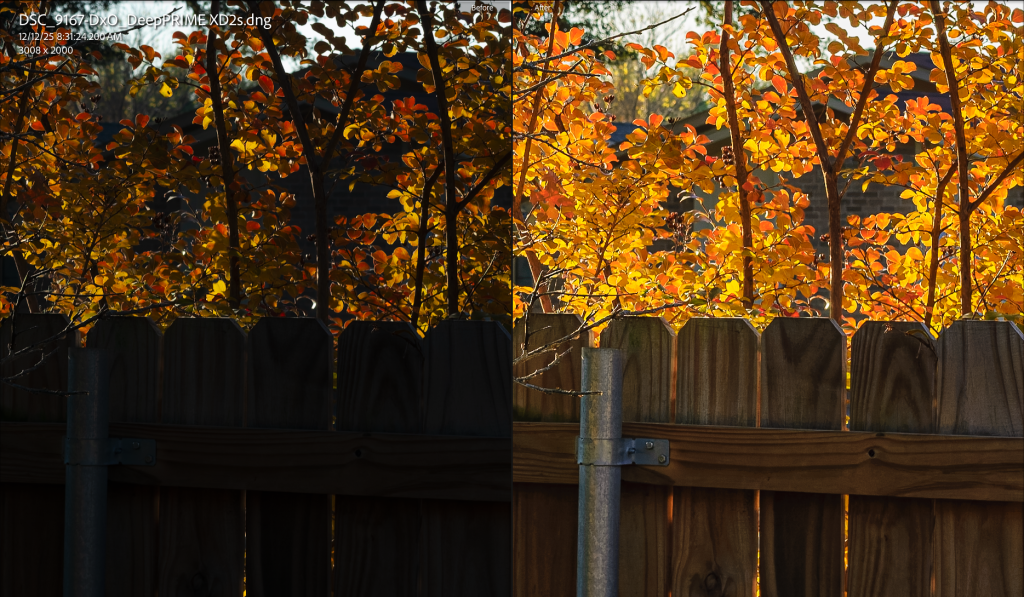
If you had to deal with recovering more than this I’d suggest you got it wrong in camera to begin with or are dealing with such a wide dynamic range scene that HDR might be needed to truly get the ultimate quality.
Be the first to comment